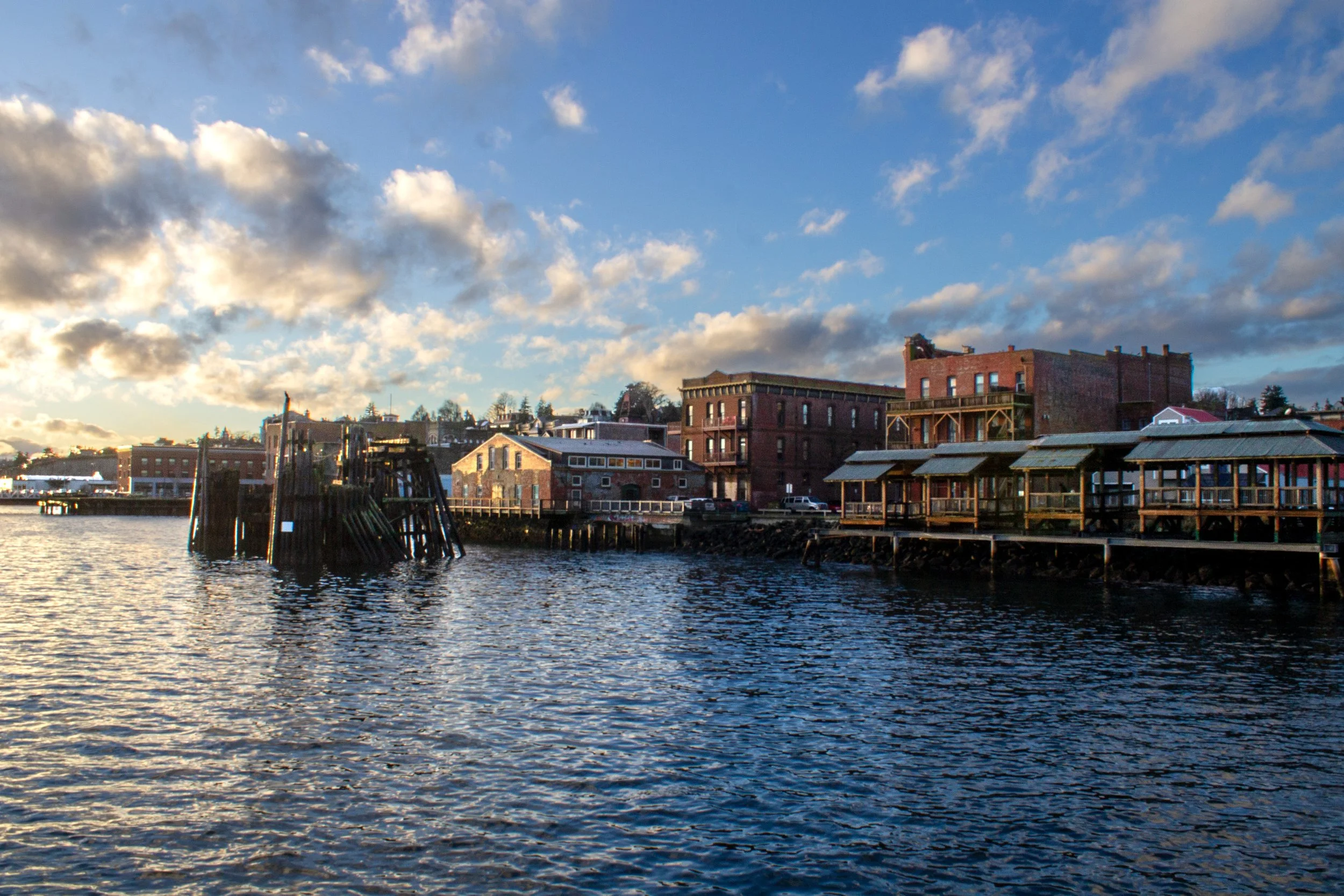
Sailing is artificial. Nobody needs to. We have our near shores, our coastal towns, the land behind them and the land beyond. But the sea calls anyway, and what it offers is a horizon.
A door we do not know how to open until other people show us, with their eyes and with their hands.
That is the tension we set out into in September, on purpose, to find our way together and to make the kind of bonds that only come from being bound to the same ship. Some would say we succeeded too well.
We left Port Townsend a crew of thirty. A third of them call Adventuress home. The rest of us were making a temporary home aboard her, to rest our heads and read the Salish Sea for four days. The task we had set ourselves was to record what we found on the water and who we had brought to it: a snapshot of what life is like, in 2026, for the people aboard. This is the first day of that record.
Adventuress is a gaff-rigged schooner, 133 feet from bowsprit to boom end, and she is a hundred and thirteen years old. Her keel first touched salt water in East Boothbay, Maine, in 1913, built for a Chicago businessman's Arctic expedition to bring home a bowhead whale, with the young Roy Chapman Andrews aboard as the museum's naturalist. She came west through the Strait of Magellan, and within a year she had been sold to the San Francisco Bar Pilots, who sailed her for more than three decades to meet ships off the Farallons. In 1952 she came north to Seattle, and she has been teaching people about the water she sails on ever since: first with Youth Adventure, and for more than thirty years now with Sound Experience, as Puget Sound's environmental tall ship. We found our way to her and asked a plain question: would she take a cohort of adults for something more expansive than a day sail, and what would it take to bring people from all over the West aboard her for four days, with time enough to contribute something and to gather?
On the morning of the 17th we gathered on the docks at the Northwest Maritime Center, having come from Boston, Chicago, San Francisco, and, some of us, from Seattle. The ship's crew and her program coordinator met us there and rounded us up. Before anything else we were photographed, properly, by a Port Townsend photographer one of our crew had arranged in advance; then the bags went aboard hand to hand down a fire chain, and we met on deck to sort ourselves into watches and to learn what leaving would ask of us. It asked more than usual, and in a good way. The wind and the berth allowed something rare.
We would sail off the dock.
Captain Gaia set her crew to the halyards and we green hands fell in behind them, our palms uncalloused against three-strand line with the tar still in it, hauling to a shanty in threes. Throat and peak went up together. Every ship has her own commands, and Adventuress is no exception, but they were not far from any other's, and by the second sail we were answering them. Slow to come off the dock, quick to be away: the dinghy stood by to see us out, the engine idled for safety's sake, and then we were in Admiralty Inlet with the sails drawing and the Strait of Juan de Fuca ahead.
The first hours on a new ship are spent learning to be one of many: to sleep, eat, wash and sail alongside people you met that morning. You set down the identity you had on land and pick up the one that lets the "us" work.
George, of the ship's crew, led each new watch through a rotation he called head, hand and heart, an hour at a station and then move on. Head was the safety of life aboard: where the equipment lives, what to do when something goes wrong, how a fire or a person in the water is handled on a wooden ship. Hand was the sailing: hauling, the rig, what standing a watch actually involves. Heart was the rest of it, the things to feel and notice about living at close quarters with twenty-nine other people. We worked round the rotation as the ship worked down the inlet.
At the mouth of the inlet, where it opens into the Strait, the one exception to every duty aboard arrived: a whale. The Salish Sea has its famous residents, the orcas, the greys, the acrobatic humpbacks. Rarer and shyer is the minke, the smallest baleen whale in these waters, about the length of an orca and without the teeth to hunt seal or salmon, known to the people who watch for her by two nicknames, the slinky minke for the way she surfaces once and vanishes, and the stinky minke for her breath. So it was an anomaly worth the name when a minke stayed with us for more than half an hour, came within two hundred feet of the hull, and at the bow rolled and showed us her underside. Around her the tide was flushing the small life out of the inlet, and the gulls were working the same water for bait.
The Strait carries the name of a Greek pilot sailing for Spain, Apostolos Valerianos, who claimed to have found it in 1592; a British fur trader put the name on the chart two centuries later, in 1787. The Klallam and the Makah, who were already here, have older names for it, and those names are older than the chart. That difference opens the older conversation.
Whose water this was before there were charts to write a name on, and who has read it longest.
We were guests in it, and the record we were keeping says so.
Between watches the crew showed us how the ship eats: how a meal for thirty comes out of a galley the size of a closet, how the dishes get done, how you keep track of your own cup. They showed us the heads, which are not toilets in the household sense but a closed system that keeps everything aboard until it can be pumped ashore, which is how a ship full of people leaves the coastal water clean. And we learned the shape of command. The captain has the whole ship, and she keeps it through her first mate, second mate and engineer; at the helm or near it she is, rightly, hard to reach, so we found our way through the watch leaders, the cook, and the other mates of good repute.
We had decided as a ship to keep no night passages, so as we came into the lee of an island the anchor went down. Dinner came with the sunset. The night brief followed, questions asked and answered, and beds were laid out, a good many of them on deck for the stars. Then the crew sang us to sleep.
Island Lab is a practice in coastal resilience: experiments in bringing people, places and ideas together, on the water and on the coasts it shapes. The log continues with the rest of the voyage, and the next gatherings, on ships we charter and on our members' own boats, are at islandlab.dev/gatherings.