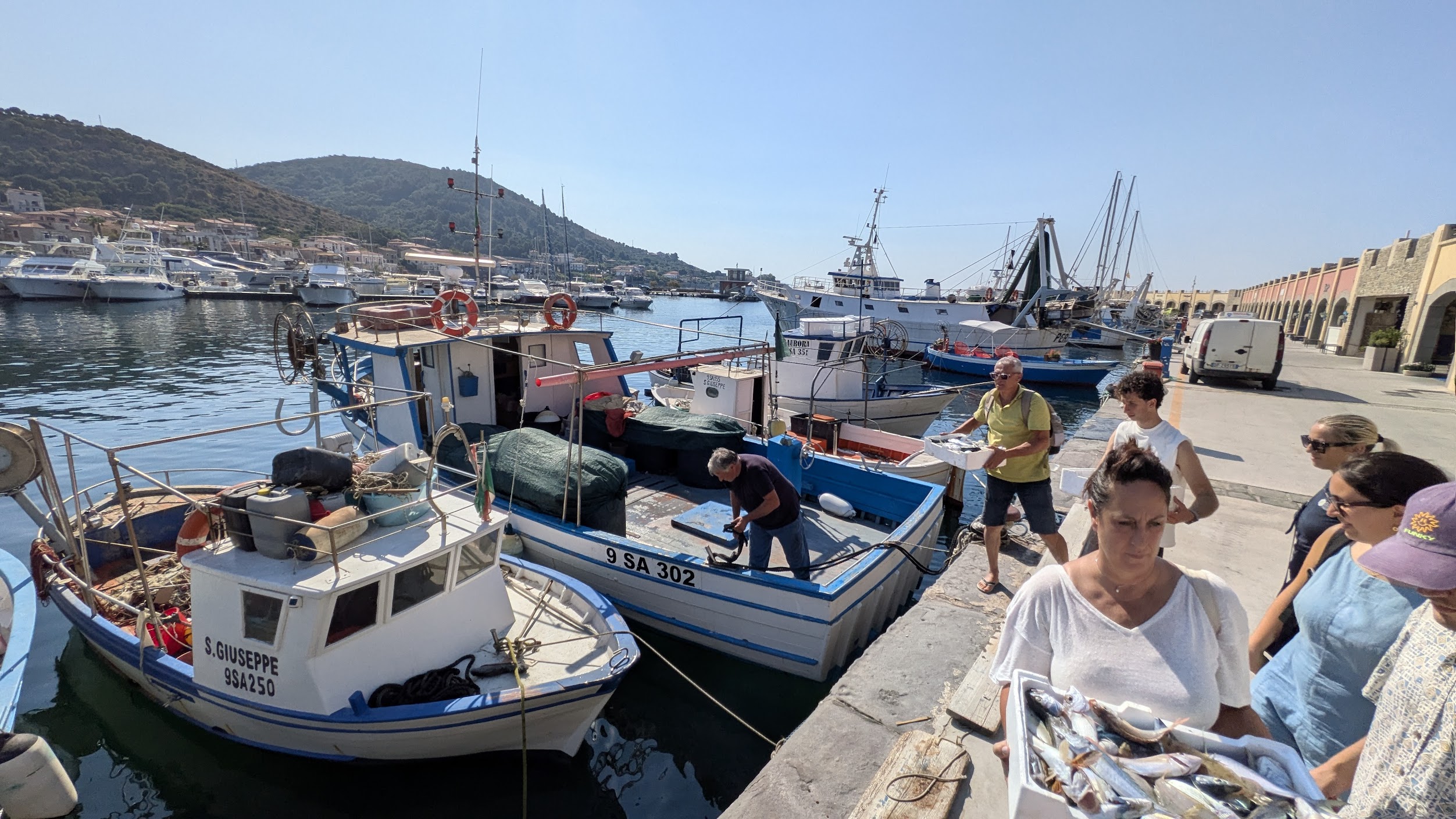
Pollica is a town of a few thousand people on the Cilento coast of southern Italy, terraced between the mountains and the Tyrrhenian Sea. It holds a UNESCO designation as an emblematic community of the Mediterranean Diet, which sounds like a designation about food and is really one about relationships: how a place grows, catches, shares, and governs what sustains it.
The invitation
We came at the invitation of Sara Roversi and the Future Food Institute, as part of Save the Ocean week. The invitation is worth dwelling on, because it says something about how this kind of work begins. We did not arrive with a proposal. We arrived through relationship, into a community that had already chosen its direction, and our job was to add hands and instruments to work that was already underway.
The relationship that preceded us
The Future Food Institute began in Bologna, growing out of Sara's conviction that food is one of the most honest lenses on how a society actually works. That work spread across Italy and well beyond it.
In 2020, Pollica's mayor, Stefano Pisani, reached out. The town was thinking hard about its ecological and food relationships and wanted a partner in that thinking. What followed became the Paideia Campus: a standing presence in Pollica where researchers, students, and residents study the town's food systems, its governance, and its coastline together.
Over five years, the frame widened. What began as a question about food became a practice of understanding relationships: between people and their land, their water, their institutions, and each other. The shift that matters most is in how the community talks to itself. Pollica has built the habit of asking, together, where it wants to go and how it intends to get there.
What we did
Our week was spent inside that habit. We met with the port and with local tour operators, the people whose livelihoods read the water daily. We walked the coastline with environmentalists and curators, learning what they watch for and what they worry about. We deployed sensors along the coast to gather baseline environmental data, built to stay in local hands as a tool the community owns. And we began assembling a governance history: how Pollica's policies and institutions have shaped its relationship with its food sources over time, so the town's next decisions can stand on a clear record of its past ones.
None of this was ours alone. Every piece was done with the people whose place this is, and every output belongs to them.
What Pollica shows about partnership
Island Lab works with coastal communities as a development partner. In practice that means reading conditions alongside the people who live with them, building the tools and records a place needs, and helping the programs, reports, and funding follow from what the community already knows. The work spans instruments in the water, documents on the desk, and the grant applications that keep both funded.
Pollica is a case study in when that work is possible. The conditions were all here before we were.
A community that was already asking its own questions. Pollica did not need to be convinced that its coastline and food systems mattered. The mayor made the first call five years ago.
An anchor relationship of trust. The Future Food Institute spent years becoming part of the town, and it was that trust, extended to us, that opened every door we walked through this week.
Work that stays. Sensors that remain on this coastline, data that remains in local hands, a governance record that remains useful long after we fly home.
This is the pattern we look for everywhere we work: communities in this posture, and partners with this kind of standing, who invite us into work that outlasts the visit.
What emerges
The clearest lesson of the week is one Pollica teaches by existing. Resilience emerges from the relationships already present in a community, seen, recorded, and supported, rather than arriving as a plan drawn up somewhere else.
That principle travels. It is the same one underneath everything Island Lab is building on the Salish Sea, where the working knowledge of fishermen, scientists, tribes, sailors, and coastal towns already holds most of what the region needs to know about itself. The work is to convene it, record it, and help it act.
What comes next
We are here another week, working with people who have dedicated their lives to understanding this coastline, and learning from them how this kind of engagement can be carried further, here and elsewhere. Our thanks to Sara Roversi, Mayor Pisani, and the whole Future Food Institute and Paideia Campus community for the invitation and the welcome.
If your community or organization is asking these kinds of questions about its own coastline, we would like to hear from you.